Wednesday, 25 July 2018

Gaugamela 331 BC - The chariot

Historical background

In the year 334 BC Alexander III of Macedonia (later called "the Great") started the invasion of the Persian Empire. After victories in the battles the Granicus and Issus he faced the whole might of Persia in the battle of Gaugamela in 331 BC. The odds were completely against him as the Persian army outnumbered him greatly (exact numbers vary: Macedonian army ca. 50.000, Persian army: 90 - 120.000, in ancient sources even 250.000 up to 1.000.000). With superior tactics of his phalanx and his cavalry he outmanouvred the Persians and put them to flight with only slight losses to his own army. The results of this battle were enormous - the Persian king Darius III was killed by his own men and Alexander was in full control of the whole Persian empire.

The moment depicted is the attack of one of the feared scythed Persian chariots. A few Greek cavalrymen try to disable the crew and stop it. The chariots which reached the Macedon lines were soon put out of action, as the phalanx opened their close formation to let them pass simply through and light troops finished them finally off.


The diorama

The challenge for this diorama was the fact that information on the appearance of Persian chariots are scarce, especially on colouring, so it is only best guess. The figures are all from Zvezda, with only minor trimming had to be done. Groundwork is made of coffee powder, paint, some moss from the garden and a little bit of marjoram. The Persians cleared the anticipated path of the chariots in the days before the battle, so that no obstacles can interfere with the attack (large stones and bushwork was removed and uneven ground was flattened), so all the ground on the diorama is quite flat and with only few vegetation.


Photos (click to enlarge)


Video (YouTube)


Sources

John Warry - Alexander 334-323 BC (Osprey Campaign 7)
Michael Thompson - Granicus 334 BC (Osprey Campaign 182)
Jack Cassin-Scott - The Greek and Persian wars (Osprey Men-at-Arms 69)
Nicholas Sekunda - The Persian army (Osprey Elite 42)
Nick Sekunda - The army of Alexander the Great (Osprey Men-at-Arms 148)
Waldemar Heckel/Ryan Jones  -Macedonian warrior (Osprey Warrior 103)
Nicholas Sekunda - Macedonian armies after Alexander  (Osprey Men-at-Arms 477)
Christopher Webber - The Thracians (Osprey Men-at-Arms 360)
Nic Fields - Tarentine Horseman of Magna Craecia (Osprey Warrior 130)
Simon Anglim/Phyllis Jestice/Bob Rice/Scott Rusch/John Serrati - Fighting techniqes of the ancient           World 3000 BC - 500 AD
Paolo Cau - Die 100 größten Schlachten

Sunday, 1 July 2018

Eastern Front 1942

Historical background

In 1942 the German army stood deep in Soviet territory. The Soviet army was only able to stop the German advance but a massive built up in the hinterlands was soon to turn the scales in Russia's favour.

For securing the lines of communications the German army used to some extent Russian cossack volunteers. They were very effective and the units were recruited from anti-communists which survived the purges by Stalin and wanted revenge.

The moment depicted in the diorama is one cossack unit on patrol looking for the enemy or partisan fighters.


The diorama

The figures are from Revell. Only minor modifications had to be done. The uniform represents the classic German cavalry uniform with a little traditional cossack touch. The well is simply made of wood and a little wire. The cornfield is a little bit complex and is made of reed (H0-scale from an unknown manufacturer), spices, tape, glue and paint - a tricky business but I like the result.


Photos (click to enlarge)


Video (YouTube)


Sources

Carlos C. Jurado - Foreign Volunteers of the Wehrmacht 1941-1945 (Osprey Men-at-Arms 147)
Jeffrey T. Fowler - Axis cavalry in world war II (Osprey Men-at-Arms 361)

Saturday, 2 June 2018

Vienna 1683 - The Poles are coming

Historical background

In the year 1683 the Ottomans started their second attempt to conquer Vienna, the seat of the Emperor of the Holy Roman Empire and the door to further conquest in Europe. It was a major effort with a huge army (170.000 men at the start of the campaign) - too much for the Emporer, who left the City before the Ottomans arrived. After an epic two months siege an allied relief army (Imperial and Polish troops) reached the outskirts of Vienna and in the final battle the Ottomans were decisively beaten and had to retreat the way they had come.

The moment depicted is a Polish march column in the Vienna Woods west of the city. The Polish troops are in a bad state, as their way to Vienna was already long and exhausting. Even their king was ashamed of them and leading them through different ways to Vienna as the rest of the Imperial army.


The diorama

The figures are all from Zvezda. The challenge for this diorama was the problem that there is only one marching pose in the Zvezda set, so some conversions had to be made. Also some trimming had to be done to convert the figures into Poles (originally they were Russian streltsi). Uniforms were not very developed in this period, so each figure has its own colour variations. The tree is scratch built of wire, putty and some weeds from the garden.


Photos (click to enlarge)


Video (Youtube)


Sources

John Stoye - Die Türken vor Wien
Simon Millar - Vienna 1683 (Osprey Campaign 191)
Richard Brezezinski - Polish armies 1569-1696 Part 1 (Osprey Men-at-Arms 184)
Richard Brezezinski - Polish armies 1569-1969 Part 2 (Osprey Men-at-Arms 188)

Tuesday, 1 May 2018

France 1940

Historical background

In 1940 the French had to witness the might of the German Blitzkrieg which swepped across the country in a scale not seen before. The French army relied solely on the Maginot line (a large static  fortification line with heavy guns). The Germans on the other side were masters of mobile warfare and crossed the Ardennes with their panzers - a possibility which the French high staff had completely ignored. In only six weeks France was defeated and Hitler visits Paris.

The moment depicted in the diorama is a German artillery piece (10,5 cm leichte Feldhaubitze 18) in an infantry support role. As the Germans had total air superiority and the French army was in very confused state even cover or Camouflage were not necessary.

The diorama

The figures are from Revell (originally from Preiser in H0) and in my opinion this is one of the best sets ever produced. No need for conversion, perfect poses, even the gun is for a soft plastic item very good. Cobblestone and the wall are made out of a plaster from a form with a little trimming.


Photos (click to enlarge)


Video (YouTube)


Sources

Alan Sheppard - France 1940 (Osprey Campaign 3)
Nigel Thomas - The German army 1939-1945: 1 Blitzkrieg (Osprey Men-at-Arms 311)

Saturday, 14 April 2018

Wagram 1809 - The big guns

Historical background

After humilating defeats in Italy and at the battle of Austerlitz the Austrian Emporer decided that it is time to strike again against Napoleon. An invasion of Bavaria was attempted but it failed and Napoleon drove the Austrians back to Vienna, the Austrians on the northern side of the Danube, the French of the southern side in the city itself with Napoleon residing in Schönbrunn. A first try to bring the Austrians to their knees failed in the battle of Aspern/Essling where Napoleon gets a bloody nose. With more vigour two months later he crossed the Danube and the battle of Wagram starts. It was one of the greatest battles of all time with a fronline of over 15 kilometers on a plain field without any features (the Marchfeld). The battle lasted more than two days and resulted in the retreat of the Austrian army. Napoleon was again master of Europe.

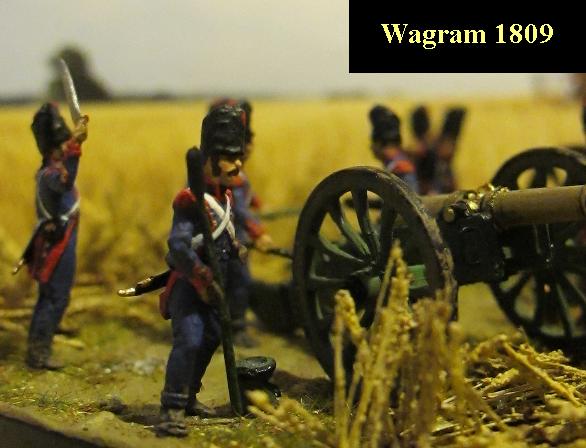
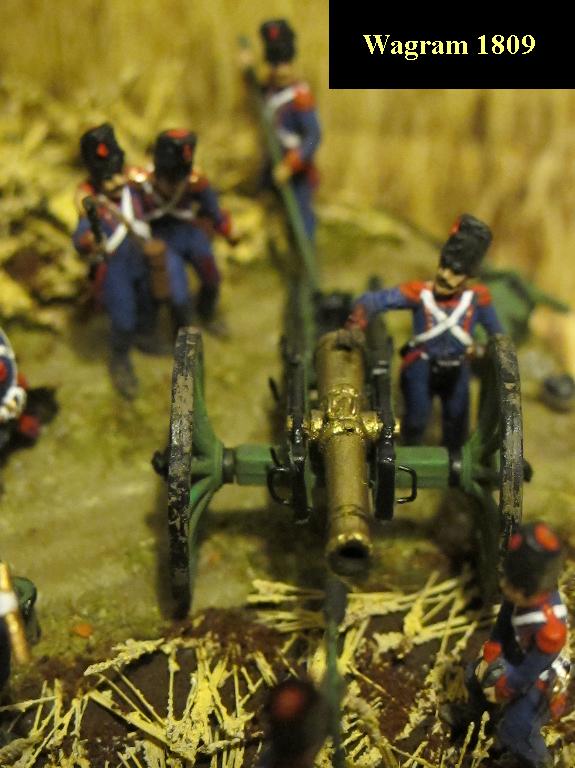
The moment depicted in the diorama is the massing of 84 cannons on day 2 of the battle. It was an attempt to stop an Austrian advance near Aderklaa which worked.


The diorama

The figures and the gun are from Esci. The figures are all in very static and not very lifelike poses, so much conversions had to be done. As the gun is very simplified (a problem with must soft plastic artillery) some details had to be added to achieve a more realistic look. The cornfield is made of reed (H0-scale from an unknown manufacturer), spices, tape, glue and paint - this time partly trampled down, as guns and soldiers had walked over it. The background is a photo from the actual battlefield taken in 2010.

Photos (click to enlarge)


Video (YouTube)


Sources

John H. Gill - 1809, Thunder on the Danube
Ian Castle - Aspern & Wagram 1809 (Osprey Campaign 33)
F. G. Hourtoulle - Wagram
Andre Jouineau - Officers and soldiers of the French Imperial guard (1)
Robert Wilkinson-Latham - Napoleon's artillery (Osprey Men-at-Arms 54)
Philip Haythornthwaite - Napoleon's specialist troops (Osprey Men-at-Arms 199)
Terence Wise - Artillery Equipments of the Napoleonic wars (Osprey Men-at-Arms 96)
Rene Chartrand - Napoleon's guns 1792-1815: 1 field artillery (Osprey New Vanguard 66)