In the year 334 BC Alexander III of Macedonia (later called "the Great") started the invasion of the Persian Empire. After victories in the battles the Granicus and Issus he faced the whole might of Persia in the battle of Gaugamela in 331 BC. The odds were completely against him as the Persian army outnumbered him greatly (exact numbers vary: Macedonian army ca. 50.000, Persian army: 90 - 120.000, in ancient sources even 250.000 up to 1.000.000). With superior tactics of his phalanx and his cavalry he outmanouvred the Persians and put them to flight with only slight losses to his own army. The results of this battle were enormous - the Persian king Darius III was killed by his own men and Alexander was in full control of the whole Persian empire.
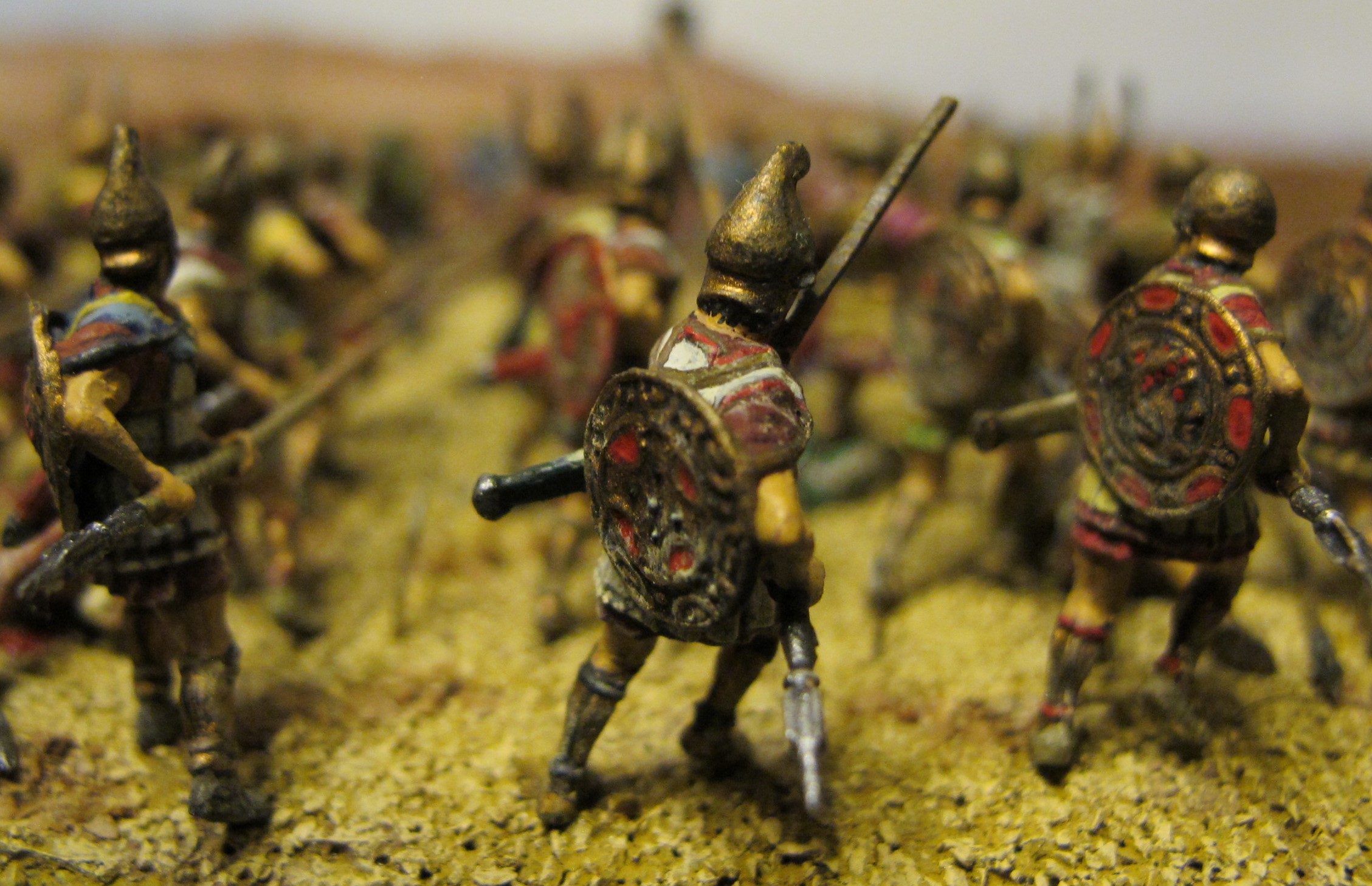
The moment depicted is the fight in the center, a Macedonian phalanx against Persian infantry.
The moment depicted is the fight in the center, a Macedonian phalanx against Persian infantry.
A phalanx usually consisted of 256 men in square formation (16 x 16), which required highly trained and disciplined soldiers. The main weapon was the sarissa, an approximately 6 meter long pike, therefore much longer than a spear of the period, which kept any enemy at bay. The phalangist was armoured with a bronze helmet, a linothorax (stiff linen upper body protection) or muscle cuirass (hard leather or bronze) and bronze greaves. Also a wooden shield with a bronze coverage was carried. This made the man a hard to hit target. On the other side the Persians infantry men were much less protected. Their shields were made of wicker, upper body armour was of minor quality if worn, the main offensive weapon was the bow - sufficent for the warfare against the usual enemies, but not against the Macedonians.
As a phalanx is nearly invulnerable from the front and normally protected on both sides by light infantry, hoplites or another phalanx, the Persians had simply not the means to defeat it although they were in much superior numbers. The Macedonians lost only 100 to 500 out of 31.000 heavy infantry men, the Persians in total 40.000 to 90.000 men.
The diorama
The challenge for this diorama is the posing of the tight Macedonian ranks to get a realistic picture and not to hinder the single figures to fight or to injure their companions - on the other side the Persians in lose formation with attempts to break an unbreakable formation. Limited poses on the Macedonian side results in much conversion work, also the Persions need some trimming.
The figures are all from Zvezda and offer the usual high quality. The Macedonians need some assembly, which creates some difficulties when painting (reaching some spaces with the brush). If there was any uniformity in appearence of the Macedonians at the beginning of the campaign, after 3 years of marching and fighting it was definitely gone (except for the sarissa). Therefore I made them a little more divers and colourful, as replacements of any kind of equipment was at least partly obtained from local resources. The sarissa ist absolute straight, but when held vertically owing to its length it tends to slack and swing a little, therefore the slightly bend pikes are quite correct.
Groundwork is made of coffee powder, paint, some moss from the garden and a little bit of marjoram. For the Persian attack with their feared chariots some parts of the battlefield were cleared, so that no obstacles can interfere with the attack (large stones and bushwork was removed and uneven ground was flattened), so all the ground on the diorama is quite flat and with only few vegetation.
Photos (click to enlarge)




Video (YouTube)
Sources
John Warry - Alexander 334-323 BC (Osprey Campaign 7)
Michael Thompson - Granicus 334 BC (Osprey Campaign 182)
Jack Cassin-Scott - The Greek and Persian wars (Osprey Men-at-Arms 69)
Nicholas Sekunda - The Persian army (Osprey Elite 42)
Nick Sekunda - The army of Alexander the Great (Osprey Men-at-Arms 148)
Waldemar Heckel/Ryan Jones -Macedonian warrior (Osprey Warrior 103)
Nicholas Sekunda - Macedonian armies after Alexander (Osprey Men-at-Arms 477)
Christopher Webber - The Thracians (Osprey Men-at-Arms 360)
Nic Fields - Tarentine Horseman of Magna Craecia (Osprey Warrior 130)
Kevin F. Kiley - Uniforms of the Greek world
Simon Anglim/Phyllis Jestice/Bob Rice/Scott Rusch/John Serrati - Fighting techniqes of the ancient World 3000 BC - 500 AD
Paolo Cau - Die 100 größten Schlachten
Paolo Cau - Die 100 größten Schlachten