Tuesday, 1 May 2018

France 1940

Historical background

In 1940 the French had to witness the might of the German Blitzkrieg which swepped across the country in a scale not seen before. The French army relied solely on the Maginot line (a large static  fortification line with heavy guns). The Germans on the other side were masters of mobile warfare and crossed the Ardennes with their panzers - a possibility which the French high staff had completely ignored. In only six weeks France was defeated and Hitler visits Paris.

The moment depicted in the diorama is a German artillery piece (10,5 cm leichte Feldhaubitze 18) in an infantry support role. As the Germans had total air superiority and the French army was in very confused state even cover or Camouflage were not necessary.

The diorama

The figures are from Revell (originally from Preiser in H0) and in my opinion this is one of the best sets ever produced. No need for conversion, perfect poses, even the gun is for a soft plastic item very good. Cobblestone and the wall are made out of a plaster from a form with a little trimming.


Photos (click to enlarge)


Video (YouTube)


Sources

Alan Sheppard - France 1940 (Osprey Campaign 3)
Nigel Thomas - The German army 1939-1945: 1 Blitzkrieg (Osprey Men-at-Arms 311)

Saturday, 14 April 2018

Wagram 1809 - The big guns

Historical background

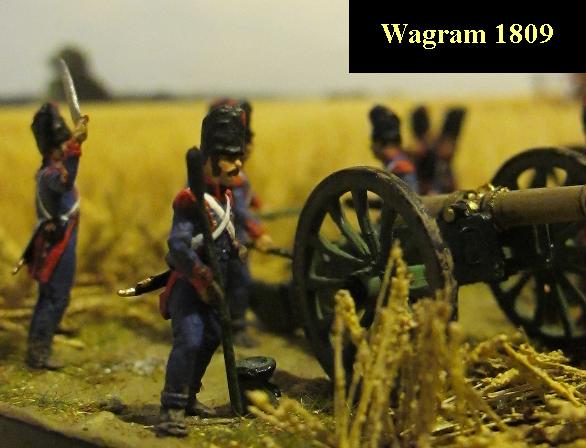
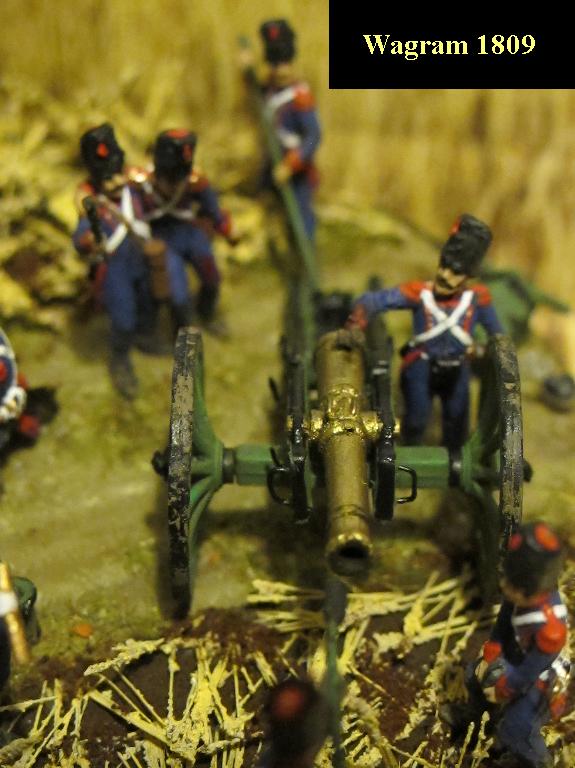
After humilating defeats in Italy and at the battle of Austerlitz the Austrian Emporer decided that it is time to strike again against Napoleon. An invasion of Bavaria was attempted but it failed and Napoleon drove the Austrians back to Vienna, the Austrians on the northern side of the Danube, the French of the southern side in the city itself with Napoleon residing in Schönbrunn. A first try to bring the Austrians to their knees failed in the battle of Aspern/Essling where Napoleon gets a bloody nose. With more vigour two months later he crossed the Danube and the battle of Wagram starts. It was one of the greatest battles of all time with a fronline of over 15 kilometers on a plain field without any features (the Marchfeld). The battle lasted more than two days and resulted in the retreat of the Austrian army. Napoleon was again master of Europe.

The moment depicted in the diorama is the massing of 84 cannons on day 2 of the battle. It was an attempt to stop an Austrian advance near Aderklaa which worked.


The diorama

The figures and the gun are from Esci. The figures are all in very static and not very lifelike poses, so much conversions had to be done. As the gun is very simplified (a problem with must soft plastic artillery) some details had to be added to achieve a more realistic look. The cornfield is made of reed (H0-scale from an unknown manufacturer), spices, tape, glue and paint - this time partly trampled down, as guns and soldiers had walked over it. The background is a photo from the actual battlefield taken in 2010.

Photos (click to enlarge)


Video (YouTube)


Sources

John H. Gill - 1809, Thunder on the Danube
Ian Castle - Aspern & Wagram 1809 (Osprey Campaign 33)
F. G. Hourtoulle - Wagram
Andre Jouineau - Officers and soldiers of the French Imperial guard (1)
Robert Wilkinson-Latham - Napoleon's artillery (Osprey Men-at-Arms 54)
Philip Haythornthwaite - Napoleon's specialist troops (Osprey Men-at-Arms 199)
Terence Wise - Artillery Equipments of the Napoleonic wars (Osprey Men-at-Arms 96)
Rene Chartrand - Napoleon's guns 1792-1815: 1 field artillery (Osprey New Vanguard 66)

Sunday, 1 April 2018

Gaynes's Mill 1862

Historical background

In 1862 the American civil war was in its second year and the Union army stood only a few miles before Richmond, the capital of the Confederacy. As Robert E. Lee, the most famous of all civil war commanders, took over command of the Confederate troops he made the decision to attack his opponent instead of digging in and await the onslaught. In a series of battles within only seven days (one of which was Gaynes's Mill) Lee pushed the Union army further and further away from Richmond and the Unionist had to give up their dream of a quick victory. The war continued till 1865 and resulted in a complete defeat of the Confederacy.

The moment depicted is the stand of the 5th New York Volunteer Regiment (also known as Duryee's Zuaves) to hold back the approaching Confederate attack wave. It was only a shortlived defence as the Southern troops overwhelmed them and they had to retreat.


The diorama

The figures are from Italeri. As there are only limited poses for the Zuaves (a quite fancyfull costume inspired by French troops) some conversions had to be done. The fence is made of wood and the shoddy tree of wire, putty and foliage by Noch.


Photos (click to enlarge)


Video (YouTube)


Sources

Angus Konstam - Seven days battles 1862 (Osprey Campaign 133)
Andre Jouineau - Officers and soldiers of the American civil war Vol. 1
Andre Jouineau - Officers and soldiers of the American civil war Vol. 2
Philip Katcher - American civil war armies 2, Union troops (Osprey Men-at-Arms 177)
Philip Katcher - Flags of the American civil war 2, Union (Osprey Men-at-Arms 258)

Tuesday, 13 March 2018

Vienna 1683 - Take their position

Historical background

In the year 1683 the Ottomans started their second attempt to conquer Vienna, the seat of the Emperor of the Holy Roman Empire and the door to further conquest in Europe. It was a major effort with a huge army (170.000 men at the start of the campaign) - too much for the Emporer, who left the City before the Ottomans arrived. After an epic two months siege an allied relief army (Imperial and Polish troops) reached the outskirts of Vienna and in the final battle the Ottomans were decisively beaten and had to retreat the way they had come.

The moment depicted is an attack by Polish troops on an Ottoman defensive line held by janissaries during the battle. After their long and exhausting march to Vienna the Poles put a final effort to overcome their Ottoman adversaries.


The diorama

The figures are from Zvezda (Poles) and Orion (Ottomans). For reaching the interaction between the figures some conversions had to be made and also the Poles had to be trimmed additionally to reach the desired appearance (originally they were Russian streltsi). Uniforms were not very developed in this period, so each figure has its own colours or colour variations. The flags are made of paper and handpainted. The tree is scratch built of wire, putty and foliage by Noch.


Photos (click to enlarge)


Video (Youtube)


Sources

John Stoye - Die Türken vor Wien
Simon Millar - Vienna 1683 (Osprey Campaign 191)
Richard Brezezinski - Polish armies 1569-1696 Part 1 (Osprey Men-at-Arms 184)
Richard Brezezinski - Polish armies 1569-1969 Part 2 (Osprey Men-at-Arms 188)
David Nicolle - Armies of the Ottoman Turks 1300-1774 (Osprey Men-at-Arms 140)
David Nicolle - The Janissaries (Osprey Warrior 58)

Thursday, 1 March 2018

Alexandria 1798 - The bombardment

Historical background

In 1798 Napoleon started his Egyptian expedition - partly to explore the Egyptian antiquities but most of all to crush the British supremacy in the Mediterranean. The Ottoman troops in Egypt had nothing to oppose the French army and soon Napoleon was in possession of Egypt and part of Syria. But the British Navy succeeded in cutting Napoleon's line of communication and this left him stranded in the Orient. Silently he withdraw from the army and returns to France in 1799.

The moment depicted in the diorama is a French artillery piece in front of the walls of Alexandria. Before the French could create massive siege lines the siege was already over - it lasted only one day. The show of force was too much for the Ottomans. That was a real luck for the French as their uniforms were made for much cooler climates and the first victims of heat stroke occured very soon and in alarming numbers.


The diorama

The figures and the gun are from Esci. The figures are all in very static and not very lifelike poses, so much conversions had to be done. As the gun is very simplified (a problem with must soft plastic artillery) some details had to be added to achieve a more realistic look. The broken wall is made of plaster, the palm tree of wire, cord, putty, copy paper and paint.

Photos (click to enlarge)


Video (YouTube)


Sources

Fabrice Delaitre - St. Jean-d'Acre, le Mont Thabor 1799
Michael Barthorp - Napoleon's Egyptian campaigns 1798-1801 (Osprey Men-at-Arms 79)
Andre Jouineau - Officers and soldiers of French Artillery (1)
Robert Wilkinson-Latham - Napoleon's artillery (Osprey Men-at-Arms 54)
Philip Haythornthwaite - Napoleon's specialist troops (Osprey Men-at-Arms 199)
Terence Wise - Artillery Equipments of the Napoleonic wars (Osprey Men-at-Arms 96)
Rene Chartrand - Napoleon's guns 1792-1815: 1 field artillery (Osprey New Vanguard 66)